Choosing a china refrigerated truck manufacturer should be straightforward on paper: compare body dimensions, cooling capacity, chassis brand, and price, then place the order. In practice, project buyers know it rarely works that way. Two suppliers may quote similar specifications, yet one truck performs reliably in daily cold-chain use while the other creates downtime, temperature claims, delivery delays, and after-sales friction.
That gap between the datasheet and the real operating result is where many procurement mistakes happen. If you are sourcing for distribution, food logistics, pharmaceuticals, municipal supply, or a dealer network, the risk is not simply “buying the wrong truck.” The larger risk is buying a truck that looks compliant during evaluation but becomes expensive, hard to support, or operationally fragile once deployed.
Why spec-sheet comparisons often fail buyers
A spec sheet is necessary, but it is not enough. It shows declared configuration. It does not show execution quality, system integration discipline, or how well the supplier understands your operating context.
This is why buyers can spend weeks comparing refrigerated truck manufacturers and still fail to reduce project risk. They compare listed specs, negotiate price, ask for photos, and request a drawing. Yet many of the issues that affect lifecycle value sit outside the headline numbers:
- Box insulation consistency
- Door sealing quality
- Refrigeration unit matching to route profile
- Chassis and body integration
- Wiring layout and serviceability
- Spare parts response
- Export documentation accuracy
- Lead time reliability
- Local compliance support
- After-sales communication quality
A truck can meet the requested temperature range in a static test and still underperform in frequent-door-open, mixed-load, high-ambient, or urban stop-start conditions. For project buyers, this is the real decision pressure: not “Which quote is lowest?” but “Which supplier lowers the chance of post-delivery problems?”
What professional buyers should evaluate beyond price
For sourcing teams and technical evaluators, the most useful buying framework is not “features first.” It is “failure modes first.” Start with what you most need to avoid.
1. Temperature control in real operating conditions
A refrigerated body is part of a system, not a standalone shell. Cooling performance depends on:
- Insulation materials and workmanship
- Thermal bridge control
- Door opening frequency
- Product loading pattern
- Refrigeration unit sizing
- Ambient climate
- Pull-down requirements
Ask suppliers how they recommend configuring the truck for your route reality, not just your target temperature. A competent refrigerated truck manufacturer in china should be able to discuss whether your use case is urban retail delivery, long-haul transfer, frozen goods, chilled produce, or mixed cargo. Each has different thermal behavior and service demands.
A direct-answer test question is useful here: What happens to box temperature stability during frequent unloading stops, and how is the unit selected to manage that? If the answer stays generic, the supplier may be selling a standard configuration rather than solving your operation.
2. Chassis-body integration
A refrigerated truck is only as reliable as the quality of integration between the chassis, box, cooling unit, electrical system, and body fittings. Misalignment here leads to vibration issues, premature wear, drainage problems, or maintenance complexity.
If you are reviewing options from isuzu refrigerated truck manufacturers or other chassis-based configurations, ask how the body build is adapted to the base platform. Chassis compatibility matters for weight distribution, service access, and long-term durability.
For example, if your project requires a high-roof van layout for city distribution, review whether the supplier has a purpose-built solution like this refrigerated truck high roof reefer van rather than forcing a generic body concept onto an unsuitable platform.
3. Total cost of ownership, not purchase price
The cheapest unit can become the most expensive if it causes:
- Product spoilage
- Delivery interruptions
- Driver complaints
- Warranty disputes
- Slow spare-parts support
- Higher fuel or energy use
- Low resale confidence
Professional buyers increasingly evaluate lifecycle cost, not just landed cost. This is especially important when comparing multiple refrigerated truck manufacturers china listings that appear similar in online catalogs.
A useful internal question is: What would one day of truck downtime cost our operation? For some fleets, that is far more important than a small upfront price difference.
The hidden cost of repeated supplier comparison
Many buyers stay in “comparison mode” too long because it feels safe. More quotations, more spreadsheets, more side-by-side tables. But repeated comparison often creates a false sense of control. It can delay the project without improving the decision.
Why? Because once suppliers all appear to meet the written requirement, the decisive factors shift from visible specs to invisible execution quality.
This is where experienced B2B buyers change the question from:
- “Who offers the lowest price for the same spec?”
to:
- “Who is most likely to deliver a smooth project with fewer surprises?”
That shift matters. It protects schedule, internal credibility, and customer commitments.
A practical case-study lens: what buyers should learn
The examples below are illustrative buying scenarios based on common project patterns, not claims tied to a single named customer.
Case study 1: The lowest quote won, but service exposure followed
A regional distributor sourced reefer trucks primarily on price. The selected supplier’s drawings and photos looked acceptable, and the cooling specification met the requested range on paper. After deployment, the fleet experienced inconsistent door sealing, slower service communication, and delayed replacement parts.
The result was not catastrophic failure. It was something more common and more damaging: constant friction. Small issues accumulated into route disruption, internal complaints, and loss of confidence in the procurement decision.
Lesson: A qualified refrigerated truck manufacturer should be assessed for serviceability and communication discipline, not only initial configuration.
Case study 2: A tighter specification still did not solve the problem
Another buyer responded to a difficult previous project by writing a more detailed specification. The document covered dimensions, temperature targets, insulation thickness, and major components. Even so, the delivered trucks struggled in high-frequency urban unloading.
The missing variable was use-case matching. The supplier built to the document, but the document did not fully represent real route conditions.
Lesson: Better paperwork helps, but better application engineering matters more. The right supplier will challenge incomplete assumptions before production starts.
Case study 3: The buyer focused on operational fit and reduced risk
A fleet project for chilled food delivery prioritized route profile, climate, maintenance access, and service response expectations during supplier evaluation. Instead of only asking “Can you build this?” the buyer asked “How should this be built for our duty cycle?”
That led to a better-matched refrigeration setup, clearer handover expectations, and fewer early-operation adjustments.
Lesson: The strongest buying outcomes usually come from suppliers who clarify risk early, not those who simply say yes fastest.
How to vet a China refrigerated truck manufacturer properly
If you are shortlisting a china refrigerated truck manufacturer, use a structured review process.
Ask for evidence, not just promises
Request:
- Detailed configuration sheets
- Body material descriptions
- Refrigeration unit integration details
- Production photos
- Export project references where available
- Typical lead times
- Spare-parts support process
- Warranty scope and exclusions
- Packing and shipping method
- Documentation support for destination market requirements
You should also ask how the supplier handles quality inspection before shipment. Serious manufacturers are comfortable discussing process, not just product.
Evaluate whether the supplier thinks like a project partner
A good supplier does not only answer questions. They improve the question. They identify missing assumptions, clarify route profile, and help align truck design with use case.
For buyers exploring cooling-system options, it is worth reviewing a dedicated solution page such as this refrigerated truck commercial cooling unit to understand how the refrigeration component fits into the broader vehicle decision.
Check compliance awareness
Cold-chain projects often cross regulatory and operational boundaries. Even if your destination market requirements differ, it helps to work with suppliers who understand the seriousness of commercial vehicle compliance and operating safety. For a useful authority reference on commercial motor vehicle oversight, see the FMCSA.
Compliance awareness is not a branding detail. It is a risk-control signal.
What signals a trustworthy manufacturer
Trust in B2B sourcing rarely comes from slogans. It comes from consistency.
Look for these signals:
- Clear technical communication
- Willingness to discuss limitations honestly
- Structured quotation details
- Stable response times
- Realistic lead times instead of optimistic guesses
- Support for after-sales process
- Thoughtful recommendations based on your route and cargo type
This is especially important if your business is building a fleet, reseller portfolio, or municipal procurement channel. Your reputation is tied to the delivered result, not just the signed order.
In adjacent vehicle categories, future-readiness may also matter. For buyers thinking more broadly about fleet transition and specialized commercial vehicles, solutions like new energy battery swap trucks show how vehicle sourcing is moving beyond one-time asset purchasing toward longer-term operational planning.
Questions to ask before issuing the PO
Before final approval, ask these direct questions:
- How is the refrigeration unit selected for my actual route profile?
- What insulation and sealing details most affect performance over time?
- Which parts are most likely to need replacement, and how are they supported?
- What is the realistic production and shipping timeline?
- What pre-delivery inspection documentation can be provided?
- How are service issues handled for export customers?
- What assumptions in my specification may need correction?
If a supplier gives vague answers at this stage, that uncertainty usually becomes more expensive after delivery.
Image suggestions
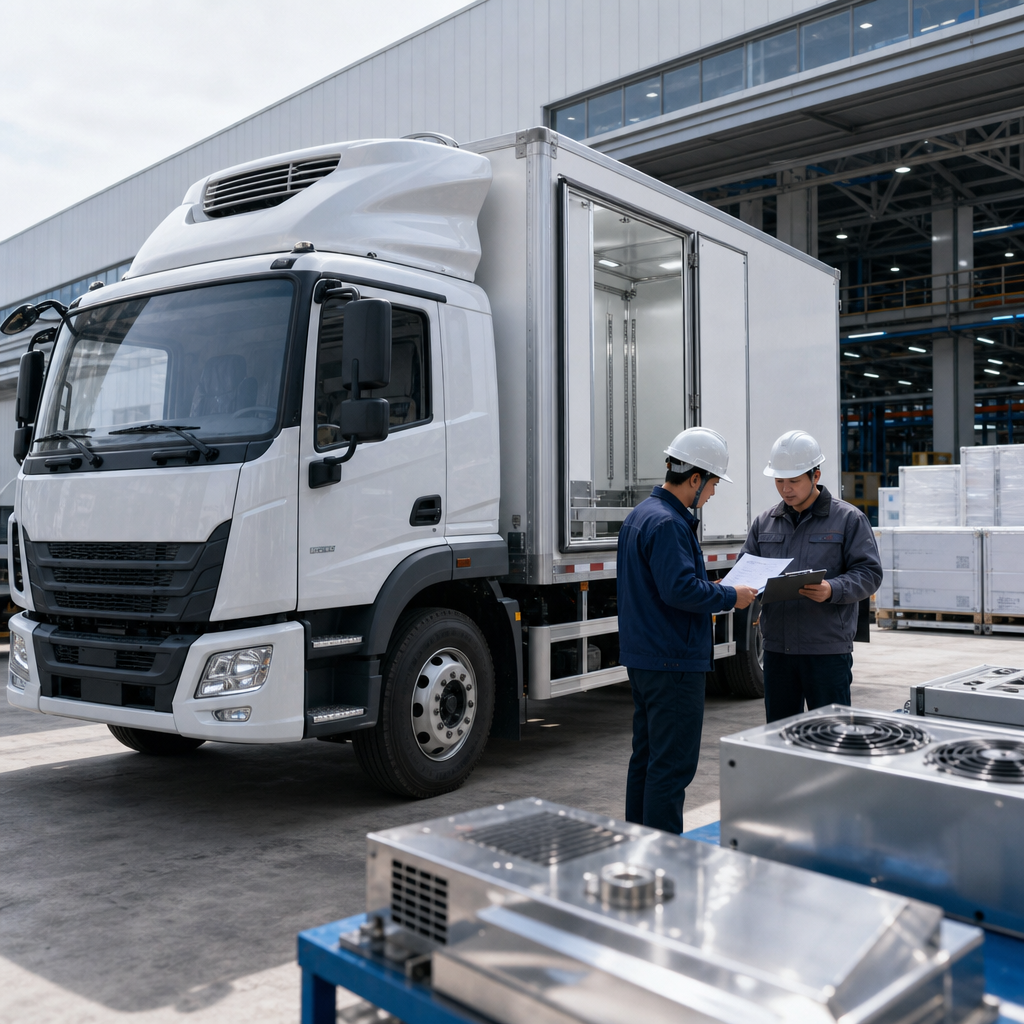
[Image placement: after the introduction — Alt text: “Project buyer reviewing refrigerated truck specification sheet and cold-chain delivery requirements”]
[Image placement: in the chassis-body integration section — Alt text: “Close-up of refrigerated truck body construction, door sealing, and cooling unit integration”]
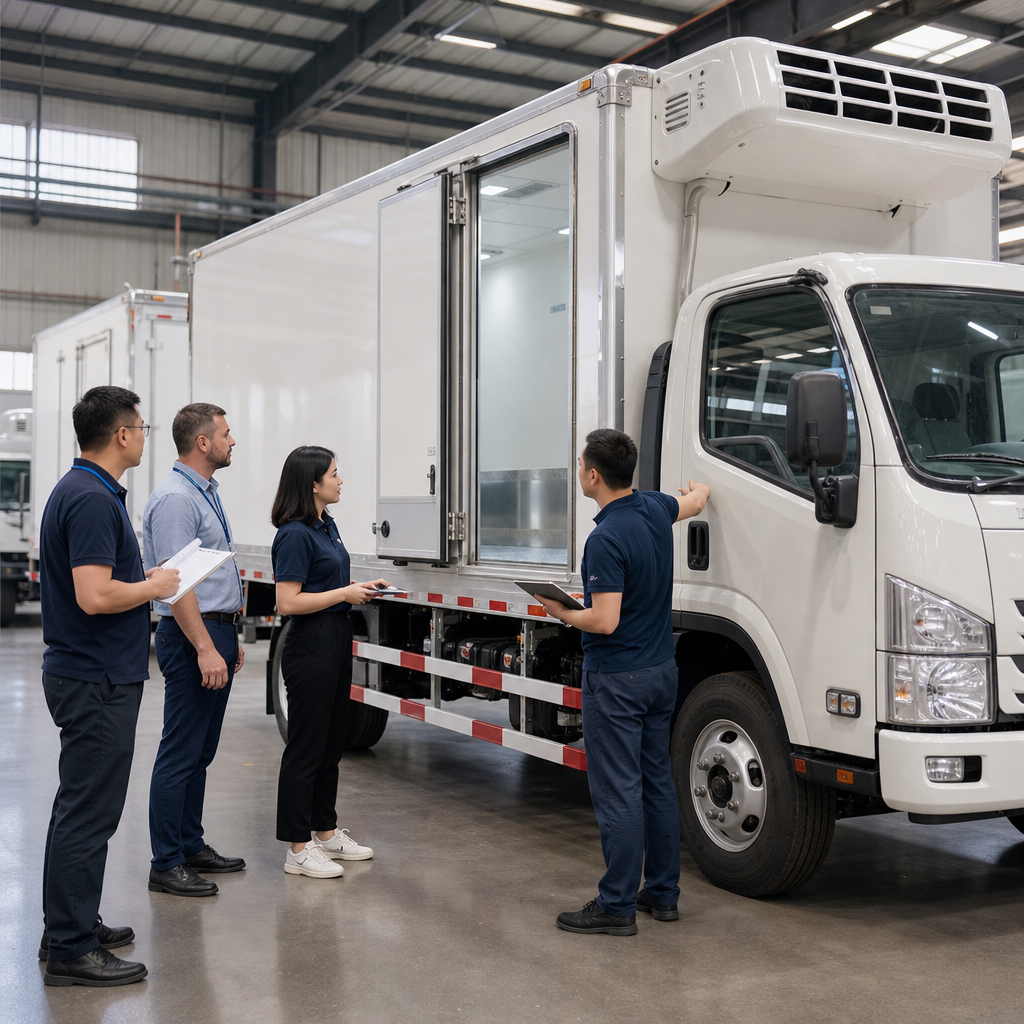
[Image placement: before the FAQ section — Alt text: “Fleet manager inspecting refrigerated trucks during factory quality review”]
FAQ
What should I look for in a china refrigerated truck manufacturer?
Look beyond listed specs and price. Evaluate temperature-control suitability for your route, body build quality, refrigeration unit matching, after-sales support, documentation accuracy, and lead time reliability. The best supplier reduces operational risk, not just upfront cost.
Are all refrigerated truck manufacturers in China similar?
No. Two suppliers may offer similar dimensions and cooling claims, but differ significantly in insulation workmanship, chassis integration, parts support, and communication quality. Those differences affect downtime, product integrity, and total cost of ownership.
How do I compare refrigerated truck manufacturers fairly?
Use a layered evaluation. Start with technical fit, then assess integration quality, warranty clarity, parts support, compliance awareness, and project communication. A fair comparison should include lifecycle risk, not only landed price.
Is price the most important factor when buying a refrigerated truck?
Usually no. For professional buyers, the bigger cost often comes from poor temperature stability, service delays, route disruption, or short asset life. A lower purchase price can become a higher operating cost if the truck is not properly matched to the application.
What is the risk of focusing only on the datasheet?
The main risk is buying a truck that appears suitable in theory but struggles in actual operations. Datasheets rarely show how the truck performs under frequent unloading, extreme ambient conditions, mixed cargo use, or long-term maintenance pressure.
Conclusion
A refrigerated truck purchase is rarely just a vehicle decision. It is a cold-chain reliability decision, a serviceability decision, and often a reputation decision. The buyers who get better outcomes are not always the ones who compare the most quotes. They are the ones who identify the real operating risk early and choose a supplier that addresses it clearly.
If you are evaluating a china refrigerated truck manufacturer for an upcoming project, start with your route reality, service expectations, and cost-of-failure exposure. Then compare suppliers through that lens. To explore suitable cold-chain vehicle options, review MagiTruck’s refrigerated truck solutions and contact the team for a practical discussion around your project requirements.