Choosing a china refrigerated truck manufacturer often looks straightforward on paper. Buyers compare dimensions, cooling capacity, chassis brand, insulation thickness, and unit price. Then the shortlist gets smaller, procurement gets slower, and risk somehow gets bigger. That is because a refrigerated truck is not just a vehicle purchase. It is a moving cold-chain asset tied to uptime, compliance, product integrity, operating cost, and customer trust.
Many sourcing teams discover this too late: two suppliers may offer similar spec sheets, yet deliver very different business outcomes. When fleets focus only on price or headline specifications, they can still end up with temperature inconsistency, delayed delivery, hard-to-source parts, weak body integration, or poor after-sales coordination.
The real buying problem is not the truck. It is the risk around the truck.
Most professional buyers are not trying to find the cheapest refrigerated truck manufacturer in china. They are trying to avoid a chain of downstream problems:
- product spoilage claims
- missed delivery windows
- difficult homologation or compliance checks
- inconsistent body quality
- weak thermal performance in real routes
- rising maintenance costs after handover
- limited technical support when something fails in operation
This is why repeated supplier comparisons often do not solve the real problem. More comparison can create the illusion of control, while the real decision criteria remain underexamined.
A better question is this: Which manufacturer reduces operational uncertainty over the full life of the truck?
That is the standard serious buyers use when evaluating refrigerated truck manufacturers for cold-chain fleets, food distribution, pharmaceuticals, municipal supply, and regional logistics.
Why price-only buying often leads to a higher total cost
A low purchase price can hide expensive consequences. In refrigerated transport, small design or execution weaknesses can multiply across routes, customers, and seasons.
Where the hidden costs usually appear
- Temperature instability in real-world use
A truck may meet catalog cooling claims but struggle with frequent door openings, partial loads, hot ambient conditions, or multi-stop urban distribution.
- Body and cooling unit mismatch
The refrigeration unit, insulation structure, and vehicle body must work as one system. A strong compressor does not compensate for poor panel construction, thermal bridging, or bad sealing.
- Downtime caused by parts and service gaps
A lower upfront price loses its appeal if replacement parts are slow to arrive or technical support is fragmented between chassis supplier, body builder, and cooling unit vendor.
- Shortened asset life
Weak workmanship around door frames, floor materials, hinges, drainage, or interior finishing can increase corrosion, damage, and maintenance frequency.
- Commercial reputation risk
For distributors and logistics operators, one failed load can cost more than a modest difference in purchase price.
For many buyers, the core issue is not “Can this truck refrigerate?” It is “Can this truck protect my business under pressure?”
Why spec sheets alone are not enough
Spec sheets matter. Serious buyers should always review payload, box dimensions, insulation details, cooling unit type, energy consumption, and chassis configuration. But spec sheets are only part of the truth.
A spec sheet cannot fully show:
- how well the body is assembled
- whether insulation quality is consistent across production batches
- how the doors perform after repeated use
- whether the layout supports fast loading and unloading
- how easy the truck is to maintain in your market
- how the supplier manages pre-delivery inspection and final quality checks
- whether after-sales responsibility is clear when issues cross subsystems
This is especially important when evaluating a refrigerated truck manufacturer for export or fleet deployment. On paper, multiple suppliers can appear equivalent. In operation, they are not.
What professional buyers should evaluate beyond price and specs
Here is a more complete framework for selecting a china refrigerated truck manufacturer.
1. System integration, not just component quality
A refrigerated truck is a combined system:
- chassis
- insulated body
- refrigeration unit
- electrical integration
- door and sealing hardware
- floor design
- drainage and hygiene details
Each component may be acceptable individually. The real question is whether they perform reliably together.
For example, when reviewing a product such as a refrigerated truck with high roof reefer van body, buyers should look beyond dimensions and ask:
- How is the body structure engineered for thermal retention?
- What is the logic behind the internal layout?
- How does the roof height affect loading efficiency and temperature management?
- Is service access practical for maintenance teams?
These questions move the evaluation from “what is included” to “how the asset will perform in daily operation.”
2. Thermal performance in operating conditions, not ideal conditions
Cold-chain buyers should ask for performance information tied to actual use cases:
- frozen vs chilled cargo
- urban multi-drop routes
- long-haul highway delivery
- hot climate operation
- frequent door openings
- pre-cooling expectations
- ambient temperature assumptions
If data is presented, it should be interpreted carefully. If exact figures are unavailable, they should be treated as [TO CONFIRM] rather than assumed.
A good supplier conversation is usually a detailed one. It covers the route profile, product type, load pattern, and expected duty cycle. That is often a sign the manufacturer understands application risk instead of simply quoting a unit.
3. After-sales clarity and parts availability
Many procurement teams underestimate after-sales until a truck enters service. Yet support quality often defines whether a supplier relationship succeeds.
Ask practical questions:
- Which parts are stocked or available on normal lead times?
- Who handles troubleshooting: chassis provider, refrigeration unit provider, or the body manufacturer?
- What documentation is provided for maintenance teams?
- How are warranty responsibilities split?
- Is remote technical support available?
This matters whether you are comparing general refrigerated truck manufacturers china or more chassis-specific categories such as isuzu refrigerated truck manufacturers. The brand badge on the cab is only one part of your support reality.
4. Build consistency across units
Fleet buyers and distributors do not buy one truck in isolation. They buy repeatability.
A supplier may deliver one strong sample vehicle, but can they maintain the same body finish, insulation quality, hardware fitment, and inspection discipline across a batch? This is where manufacturing controls matter more than brochure language.
Ask for:
- production photos
- quality inspection checkpoints
- reference export configurations
- packaging and shipping methods
- standard documentation sets
Consistency reduces rework, buyer stress, and disputes after delivery.
5. Future readiness and energy transition
Not every fleet is ready to shift immediately, but many buyers are already planning for lower-emission logistics, urban regulations, and cleaner municipal operations.
That makes it useful to work with a manufacturer that understands more than one vehicle category. For example, MagiTruck’s broader portfolio includes solutions such as new energy battery swap trucks, which signals familiarity with evolving commercial vehicle requirements beyond a single body type.
This does not mean every buyer needs an electric refrigerated vehicle today. It means future-readiness, engineering adaptability, and platform thinking are becoming part of supplier credibility.
Case studies: how buyers can choose the wrong truck for the right reasons
Below are composite examples based on common B2B procurement patterns.
Case study 1: The lowest quote created the highest friction
A regional food distributor shortlisted three refrigerated truck manufacturers. One supplier won on price and headline cooling capacity. The truck looked competitive in the tender review.
The issue appeared after deployment: frequent door cycles on urban routes made temperature recovery slower than expected. The fleet then had to adjust loading practices, extend route buffers, and increase monitoring. None of those costs were visible in the original quote.
Lesson: A strong specification on paper is not enough if the truck is not matched to the route profile.
Case study 2: Similar specs, very different ownership experience
An importer compared two suppliers offering near-identical box dimensions and refrigeration configurations. The lower-cost option saved money upfront, but documentation was incomplete and after-sales communication became fragmented between component parties.
The higher-value option cost more initially but arrived with clearer technical files, more coordinated support, and fewer post-delivery uncertainties.
Lesson: Professional buyers are not just purchasing hardware. They are purchasing execution confidence.
Case study 3: A cooling unit was treated as the whole solution
A buyer focused heavily on the refrigeration brand and overlooked the body system. The cooling unit itself was reputable, but the vehicle later showed issues around sealing, interior wear points, and service access.
Reviewing a dedicated refrigerated truck commercial cooling unit solution can help buyers think more carefully about how the refrigeration package fits the complete truck, not just the unit nameplate.
Lesson: The cold chain depends on system integration, not a single component.
Compliance and operational discipline still matter after purchase
Even the right truck can underperform if operations are weak. Buyers should align vehicle selection with driver training, loading discipline, maintenance intervals, and route planning.
For fleets operating internationally or benchmarking regulatory expectations, authority guidance can also be useful. The Federal Motor Carrier Safety Administration provides broader information relevant to commercial vehicle safety and operational oversight.
In practice, a dependable refrigerated truck program combines:
- sound vehicle specification
- realistic operating procedures
- preventive maintenance
- clear accountability between buyer and supplier
How to assess a refrigerated truck manufacturer in china more intelligently
If you are evaluating a refrigerated truck manufacturer in china, use this short checklist:
- Does the supplier ask about your cargo, climate, route type, and unload frequency?
- Can they explain body design logic, not just list materials?
- Is after-sales responsibility clearly defined?
- Can they support repeat orders with consistent quality?
- Do they provide useful documentation for import, maintenance, and operation?
- Are they helping you reduce long-term risk, or only trying to win on headline price?
The right supplier conversation should feel specific, disciplined, and grounded in use case reality.
Image suggestions
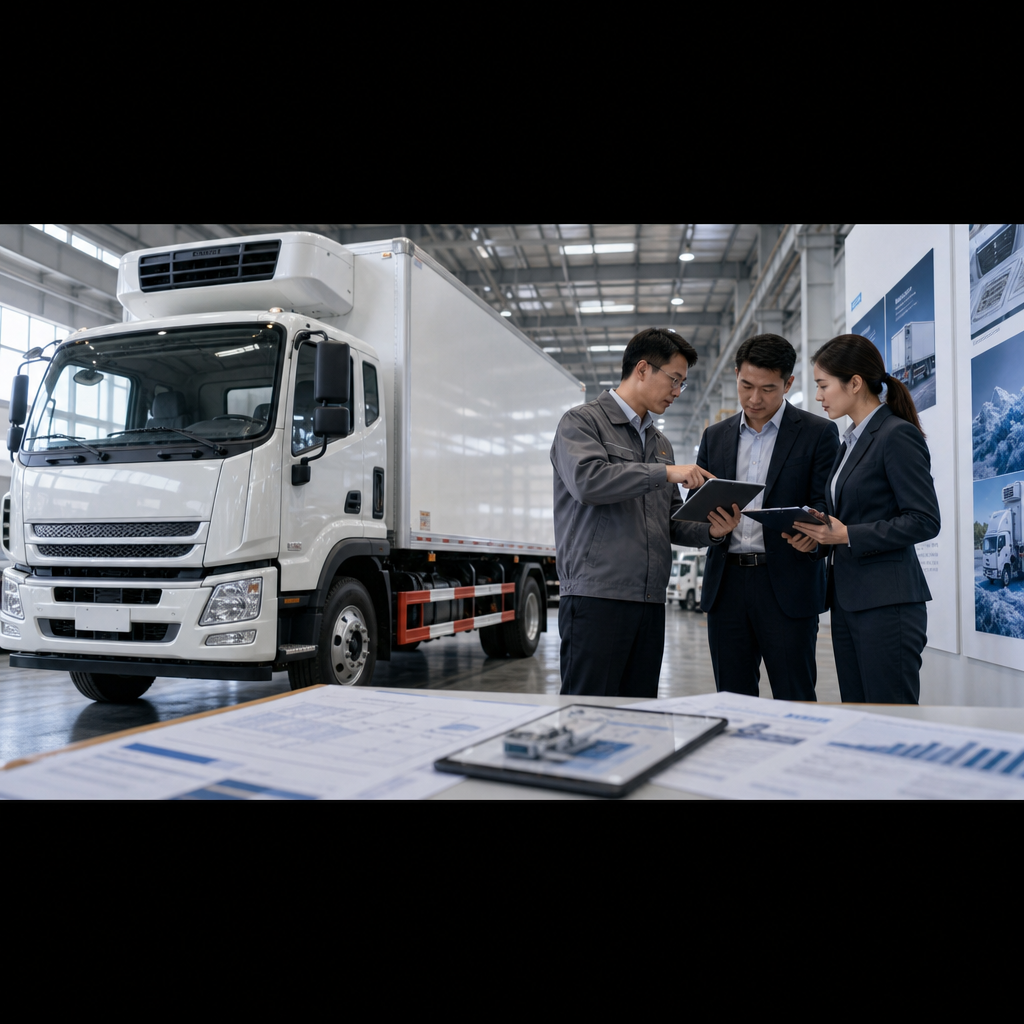
[Image suggestion: Procurement team inspecting a refrigerated truck body and door seal during factory acceptance testing. Alt text: “B2B buyers evaluating refrigerated truck body quality and door sealing at manufacturer facility”]
[Image suggestion: Cutaway diagram of refrigerated truck showing chassis, insulated body panels, cooling unit, and airflow path. Alt text: “Integrated refrigerated truck system with insulated body and commercial cooling unit”]
[Image suggestion: Urban cold-chain delivery truck at loading dock with temperature-sensitive cargo. Alt text: “Refrigerated delivery truck supporting multi-stop cold chain logistics operations”]
FAQ
What should I look for in a china refrigerated truck manufacturer?
Look beyond price and nominal specifications. Evaluate system integration, insulation quality, body construction, cooling performance in real operating conditions, parts availability, documentation, and after-sales accountability. The best supplier is usually the one that reduces uncertainty after delivery, not just before purchase.
Are all refrigerated truck manufacturers in china the same?
No. Two manufacturers can offer similar-looking trucks with very different build consistency, thermal retention, service support, and documentation quality. Differences often appear during operation, maintenance, and batch repeatability rather than in the first quotation.
Why are spec sheets not enough when buying a refrigerated truck?
Spec sheets show declared features, but they do not fully reveal workmanship, serviceability, route suitability, or long-term reliability. A refrigerated truck is a working cold-chain system, so real-world performance depends on how the body, refrigeration unit, seals, floor, and chassis work together.
How do I compare refrigerated truck manufacturers fairly?
Compare them using total cost of ownership and operational fit, not just purchase price. Review route profile, cargo type, ambient conditions, service support, warranty clarity, documentation quality, and manufacturing consistency. This gives a more reliable basis for selection.
Do chassis brands matter more than the refrigerated body?
Both matter, but for temperature-sensitive transport, the body and cooling integration are often underestimated. Even when buyers compare categories like isuzu refrigerated truck manufacturers, the chassis brand alone does not guarantee cold-chain performance. Body quality, insulation integrity, and after-sales coordination remain critical.
Conclusion
Buying from a china refrigerated truck manufacturer should not feel like a gamble disguised as a spec comparison. The real decision is not who offers the shortest quote or the longest feature list. It is who helps you protect uptime, cargo integrity, customer confidence, and long-term fleet value.
If you are reviewing suppliers and want a more practical conversation about refrigerated truck fit, not just refrigerated truck specs, explore MagiTruck’s refrigerated solutions or contact the team to discuss your operating requirements in detail.